You walk a job, scope it out, and tell the customer a number. But what do you call that number? On the truck, “quote,” “estimate,” and “bid” get tossed around like they all mean the same thing. They don’t. The word you use sets the customer’s expectation about whether your price can change, and that one difference can decide whether a job nets the margin you planned or eats it.
If you’ve ever had a customer push back with “but you said it would be cheaper,” the gap usually started with using the wrong term up front. Here’s the plain-English breakdown of quote vs estimate vs bid, when each one fits, and how to write the kind that actually protects you.
The short version
All three are a price you give a customer before the work happens. The difference is how locked-in that price is and how the customer is supposed to read it.
- Estimate: an educated guess. The final price can move once you see what’s really going on.
- Quote: a fixed price. You commit to the number, and barring a change in scope, that’s what they pay.
- Bid: a formal offer to win a specific job, usually one you’re competing for against other contractors.
What an estimate really means
An estimate is your best read on what a job will cost based on what you know right now. It’s the right call when the scope isn’t fully nailed down. Think a re-pipe behind a wall you haven’t opened, a tree removal where you can’t see all the rot, or a cleanup where the damage might be worse once you dig in.
Because it’s a guess, an estimate gives you room to adjust. That’s the upside. The downside is that customers hear a number and tend to treat it as the price, not a range. If the final bill comes in 30% over the estimate with no explanation, you’ve got an unhappy customer even if you did nothing wrong.
Protect yourself by being specific. Label it clearly as an estimate, note what it’s based on, and spell out what would push the price up: “Estimate assumes existing wiring is to code. If we find anything that needs replacing, we’ll call you before doing the work.” That one sentence turns a surprise into an expected possibility.
What a quote really means
A quote is a firm, fixed price. When you quote a job, you’re telling the customer: this is the number, and it won’t change unless the work itself changes. Quotes work best when the scope is clear and you can predict your costs: a standard water heater swap, a seasonal lawn package, a flat-rate drain clearing, a recurring cleaning.
Customers love quotes because there’s no guesswork. They know exactly what they’re paying, which makes them faster to say yes. The catch is that the risk shifts to you. If you quote a flat $450 and the job takes twice as long as you figured, you eat the difference. So only quote what you can scope tightly, and build in a buffer for the normal stuff that goes sideways.
The quote vs estimate decision really comes down to one question: do you know enough to commit to the number? If yes, quote it and win the job on certainty. If no, estimate it and protect yourself with clear conditions.
What a bid really means
A bid is a formal price you submit to win a defined piece of work, almost always when you’re competing against other contractors. You see bids on bigger projects: a general contractor asking three subs to price the same scope, a property manager collecting offers, a municipal or commercial job that goes out for tender.
A bid is usually built on a fixed scope of work that the customer defines, so in practice it behaves like a quote: a committed price for a clearly written job. The difference is the context. A bid is a competitive offer, often more formal, sometimes with a deadline and required documents. If you’re a one-truck operation doing residential service calls, you’re writing quotes and estimates far more often than bids. Bids show up when you start chasing larger, scoped projects.
Why the word you choose matters
This isn’t just vocabulary. In a lot of places, a written quote can be treated as a binding offer once the customer accepts it, while an estimate is understood to be approximate. Calling a guess a “quote” can lock you into a number you can’t actually hit. Calling a firm price an “estimate” can leave money on the table and invite haggling.
A few habits keep you out of trouble:
- Pick the term on purpose. Decide whether you’re committing to the price or guessing at it, then use the matching word.
- Put it in writing. A verbal number is the easiest thing in the world to misremember. A line-item document removes the argument.
- Spell out what’s included and excluded. Most disputes aren’t about the number. They’re about whether haul-away, permits, or parts were part of the deal.
- Add an expiration date. Material prices move. “Valid for 30 days” protects you when a customer sits on it for two months.
A quick way to decide on any job
Before you write a number down, run it through three questions. Can I see the full scope, or is some of it hidden? Can I predict my costs closely, or are there real unknowns? Am I competing for this against other contractors, or is it just me and the customer?
Full scope plus predictable costs equals a quote. Hidden scope or real unknowns equals an estimate with clear conditions. Competing on a defined scope equals a bid. Get that right up front and you spend a lot less time arguing about the final invoice.
How Zoop helps
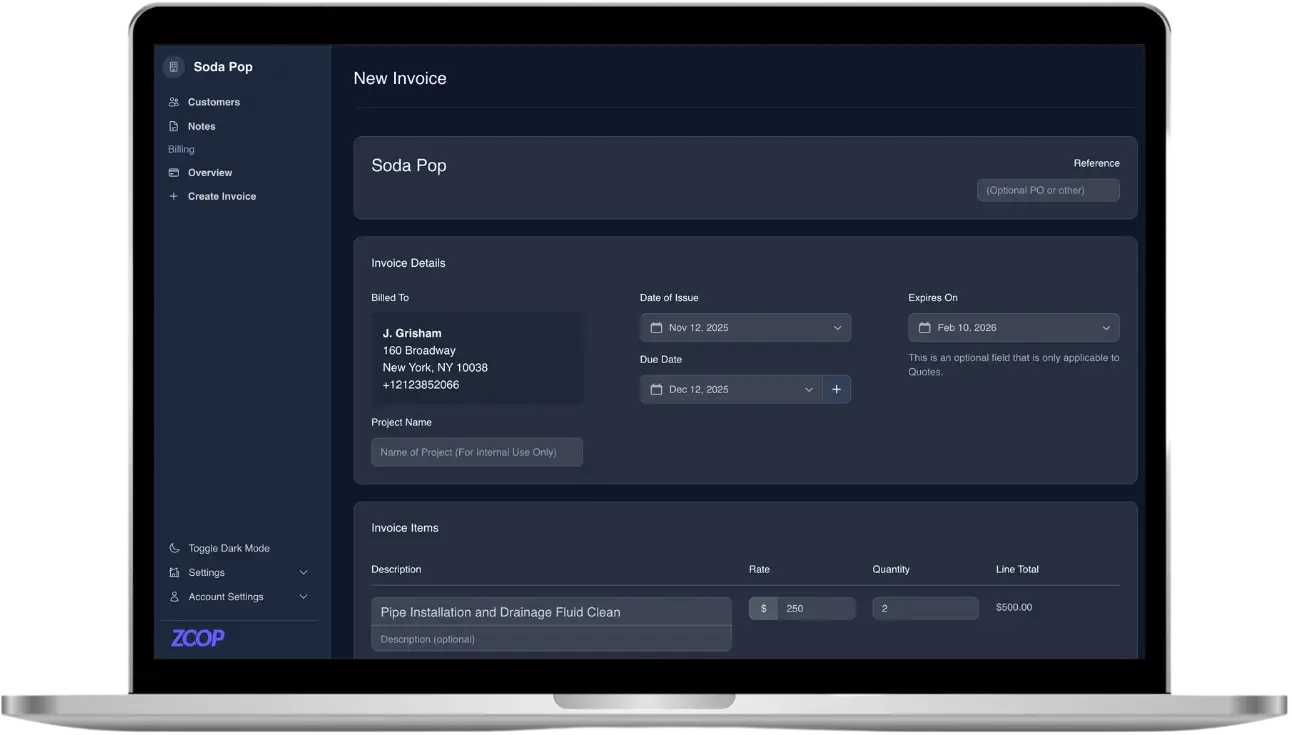
Whatever you call the number, Zoop helps you put it on paper fast and turn a yes into money. Build a quote from line items in your Pricebook, apply the right tax rate, and send a clean PDF. When the customer approves, convert that quote to an invoice in one click instead of rebuilding it. From there, you can take payment with a secure payment link the customer opens on their phone (no login) and pays by card or bank transfer, with Apple Pay and Google Pay surfaced by Stripe, or record a cash, check, Zelle, Venmo, or Cash App payment by hand if they paid you another way.
Recurring quotes and jobs, scheduling on a day, week, or month calendar, a dispatch board, automatic dunning reminders on unpaid invoices, and membership plans with customer-authorized auto-pay all live in the same place, so the price you quote actually turns into a paid, scheduled job.
Zoop is free during beta. Start your account at https://app.zoop.pro/start and send your next quote in minutes.